Most are MCP servers. Almost none publish their prompts. Here's what the data says.
Why I did this
If you build AI Actors on Apify, you're competing in a market most people don't realize exists yet. I wanted to know how big it is, who's building, what they're building with, and where the quality bar sits.
So I pulled every community-maintained AI-tagged Actor updated within the last 90 days. Identifiable author. Confirmed LLM in the pipeline. 43 Actors made the cut.
Then I started looking at patterns.
Pattern 1: It's overwhelmingly a Claude ecosystem
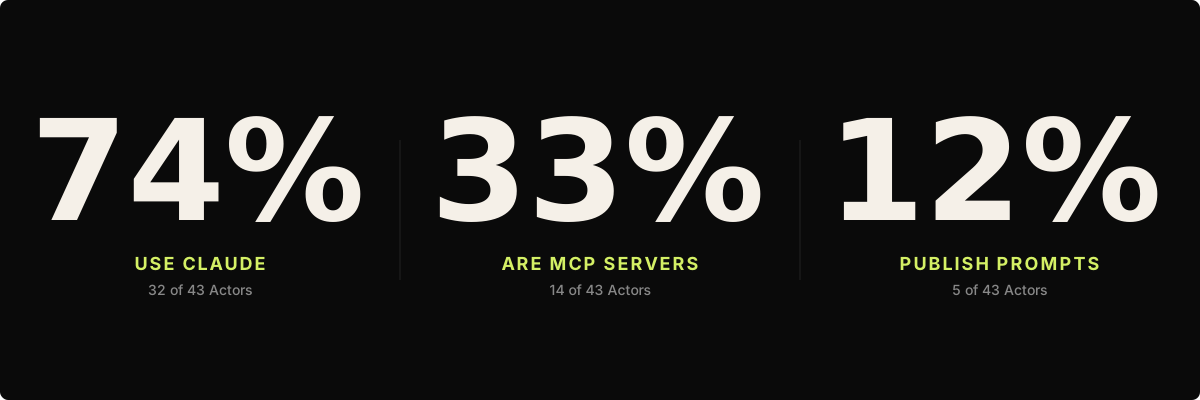
32 of 43 Actors (74%) use Anthropic Claude in their pipeline. Most use Claude exclusively or list it as the recommended model in BYOK setups.
This is striking. In broader market share, GPT still leads. On Apify Store, in the AI Actor category specifically, Claude has decisive mindshare. A few reasons stand out:
The MCP protocol, originated by Anthropic, has become the dominant pattern for new AI Actors. Of the 32 Claude-using Actors, roughly half are MCP servers. BYOK setups consistently default to Claude. Actor authors building for technical buyers appear to optimize for Claude's structured-output reliability over raw model capability.
The wedge is clear: if you want to influence the AI Actor builder community, you ship for Claude first.
Pattern 2: One in three Actors is an MCP server
14 of 43 Actors are MCP servers exposing tools to Claude, Cursor, and other MCP-compatible clients. The catalog spans domain intelligence, Reddit search, weather, crypto, automotive listings, jobs, reviews, travel, RAG browsers, EU compliance, Vinted marketplace data, lead enrichment, and database access.
This is a category that didn't exist a year ago. The Apify Store is becoming a distribution layer for MCP servers in the same way the Chrome Web Store became one for browser extensions. The economics work: an MCP server developer gets discovery, billing, scaling, and tax handling without writing any of it. They build the protocol, Apify monetizes the runtime.
If you're shipping MCP servers anywhere, Apify is probably the second or third place to publish. If you're not, you're missing a free distribution channel.
Pattern 3: Almost nobody publishes their prompts
Of 43 Actors, only 5 included a representative prompt in their README. The other 38 ship the Actor and hide the prompt.
This is rational. Prompts are IP. Authors don't want competitors copying them. So the prompt stays closed-source even when the rest of the Actor isn't.
But it creates a real problem: how does anyone evaluate whether an Actor's prompt is any good before they pay for it? Reviews tell you about output, not input. Pricing tells you about cost, not quality. The actual driver of output quality, the prompt itself, is invisible to buyers.
This is the AI input quality problem in concrete form. The thing that determines what the Actor produces is the thing nobody can see.
What This Means For Prompt Quality
PQS is the prompt quality score. It runs pre-flight, scoring prompts across 8 dimensions and 5 frameworks (PEEM, RAGAS, MT-Bench, G-Eval, ROUGE) before the LLM call happens. The score is a number between 0 and 100, mapped to grades A through F.
For Actor authors, PQS solves the prompt opacity problem in a useful way. You can prove your prompt is high-quality without revealing the prompt itself. A TLS certificate proves a server's identity without exposing the private key. A PQS grade proves a prompt's quality without exposing the prompt.
For Actor users, PQS is the quality signal that doesn't currently exist. Two Actors with identical features at identical prices, one with a B+ prompt and one with a D+ prompt, will deliver measurably different output. Today, you find out after you pay. With PQS, you find out before.
PQS is the fastest way to get better output from any AI model. Pre-flight, not post-hoc. Cheaper than one bad prompt.
An Open Offer
Of the 5 Actors that did publish prompts in their README, I'll be scoring them in a follow-up piece, with permission first. Top performers get featured. The rest get specific feedback on what to fix, free.
If you build AI Actors on Apify and want your prompts scored publicly, send them to me. Full PQS rubric, no charge, full transparency on methodology. Top scorers get a feature post and a verified badge for their Actor listing. Everyone else gets a written grading with the specific dimensions to improve.
PQS is to MCP servers what Google Search Console is to websites: the layer that tells you what's working and what isn't, so you can make decisions on data instead of vibes.
The AI input quality problem is real, and PQS named it.